Faithful Without Certainty: How Americans Keep Praying Even as They Question Whether It Works
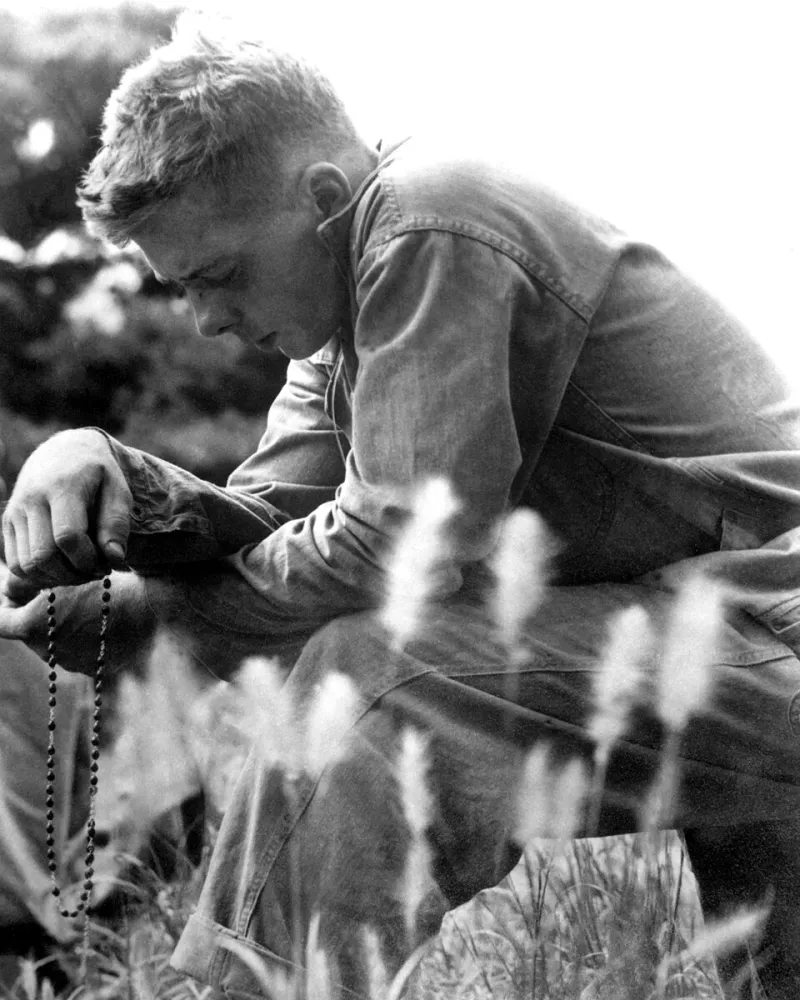
Photo: Corporal Eugene Suarez, Public domain, via Wikimedia Commons
Something unusual is happening in the spiritual lives of Americans. They are praying more than many observers expected in an increasingly secular age, yet simultaneously growing less confident that prayer changes external outcomes. This is not apathy. It is, by most accounts, a profound reckoning—one that is quietly reshaping how individuals across faith traditions understand the act of reaching beyond themselves.
A 2023 Pew Research Center survey found that roughly half of American adults say they pray daily. Yet a separate body of research, including longitudinal studies from the Barna Group, shows that confidence in petitionary prayer—the belief that asking God or a higher power for specific outcomes will yield tangible results—has declined measurably over the past two decades. The numbers do not cancel each other out. They coexist, and their coexistence points to something genuinely new.
The Collapse of the Cosmic Vending Machine
For generations, a particular model of prayer dominated much of American religious life: the petitionary model, in which the faithful make specific requests of a personal God who may choose to intervene. Theologians have always recognized the limitations of this framework, but it nevertheless held enormous popular appeal. It was legible. It was measurable. An answered prayer was a prayer that delivered.
What researchers are now documenting is a widespread disillusionment with this transactional model—not a wholesale abandonment of prayer, but a renegotiation of its terms. Psychologist Dr. Kenneth Pargament of Bowling Green State University, whose decades of research examine religion as a coping mechanism, has written extensively about the way people reframe spiritual expectations after loss or trauma. His findings suggest that when petitionary prayer fails to produce hoped-for outcomes, many practitioners do not abandon prayer itself. Instead, they revise what they believe prayer is for.
"The shift we're seeing," one interfaith chaplain working in a large Midwestern hospital told Global Prayers, "is from prayer as a request form to prayer as a practice of orientation. People are still praying. They're just no longer sure they're asking for anything specific."
What the Data Actually Shows
The statistics reward careful reading. While daily prayer rates remain substantial, surveys consistently reveal that younger Americans—particularly Millennials and Generation Z—are far more likely than their elders to describe prayer in non-interventionist terms. When asked what they believe prayer accomplishes, this demographic cohort frequently selects responses centered on emotional regulation, self-reflection, and a sense of connection rather than divine action.
This is not a fringe phenomenon. A 2022 survey conducted by the Public Religion Research Institute found that among Americans who pray regularly, a growing plurality describes the primary benefit of prayer as "inner clarity" or "emotional peace" rather than "answers from God." Even among self-identified evangelical Christians—a group historically committed to robust petitionary prayer—researchers have noted a softening of certainty around what prayer materially produces.
The implications for interfaith dialogue are significant. When Americans from different traditions compare notes on prayer, they increasingly find that the experiential language—stillness, attention, a felt sense of presence—travels across doctrinal boundaries more readily than the theological claims once did.
Borrowed Frameworks, Deepened Practice
One driver of this shift is the extraordinary cross-pollination of contemplative traditions that has characterized American spiritual life over the past half-century. Mindfulness practices rooted in Theravāda Buddhism entered mainstream clinical settings beginning in the 1970s and 1980s, largely through the work of figures such as Jon Kabat-Zinn. Centering Prayer, a Christian contemplative method revived by Trappist monks in the same era, drew explicit parallels to Eastern meditation. Sufi dhikr, Jewish hitbonenut, and Indigenous talking-to-the-land practices have each, in various ways, entered the broader American spiritual conversation.
What these traditions share—and what distinguishes them from purely petitionary models—is an understanding of prayer as transformation of the one who prays, rather than transformation of external circumstances. The practitioner is not waiting for an answer. The practitioner is, in some sense, becoming the answer.
For many Americans navigating doubt, this framework offers a way to remain engaged with prayer without requiring metaphysical certainty. "I stopped believing God was going to fix my situation," said one woman in her late forties who attends a progressive Protestant congregation in the Pacific Northwest. "But I kept praying because I noticed that I was different when I did. Calmer. Less reactive. More capable of showing up for the people around me."
The Neuroscience of Uncertain Prayer
Scientific research has, perhaps inadvertently, provided intellectual scaffolding for this revised understanding. Neuroimaging studies have documented measurable changes in brain activity associated with sustained contemplative practice, including reduced activation in the default mode network—the neural circuitry associated with rumination and self-referential thought. Researchers at Harvard Medical School and elsewhere have linked regular meditation and prayer to reductions in cortisol levels and improvements in markers of psychological resilience.
Critically, these benefits appear to accrue regardless of the practitioner's theological beliefs about whether prayer is "working" in any supernatural sense. The body, it seems, does not require doctrinal certainty to respond to contemplative discipline.
This finding is not without controversy. Some theologians worry that reducing prayer to its neurological correlates strips it of its essential character—its relational, transcendent dimension. Others argue that the science simply illuminates one dimension of a phenomenon that has always been larger than any single description could capture.
Redefining the Answered Prayer
Perhaps the most consequential development in this evolving landscape is the way Americans are redefining what it means for a prayer to be answered. In classical petitionary theology, an answered prayer was relatively straightforward: you asked, and the thing you asked for came to pass. The new frameworks are considerably more subtle.
Spiritual directors, therapists who integrate faith into clinical practice, and interfaith clergy interviewed for this article described a consistent pattern: their clients and congregants increasingly interpret answered prayer in terms of interior shifts—unexpected courage, the capacity to forgive, a release of anxiety, a sense of accompaniment in suffering. The external circumstances may remain unchanged. The person within them has moved.
This is not a new theological idea. Mystics from Meister Eckhart to Rumi to Simone Weil have articulated versions of it across centuries and traditions. What is new is its migration into the mainstream of American spiritual life, carried there not primarily by theologians but by ordinary practitioners working through ordinary disappointments.
A Practice in Search of Its Own Language
The challenge facing this emerging sensibility is linguistic. The old vocabulary of prayer—petition, intercession, answered prayer, divine will—carries assumptions that no longer fit the experience many Americans are describing. The new vocabulary, borrowed from psychology and contemplative studies, sometimes feels clinical or insufficiently sacred.
Interfaith communities, spiritual direction programs, and even some seminary curricula are beginning to grapple with this gap. How do you teach prayer when its purpose is no longer agreed upon? How do you sustain a community of practice when members hold radically different expectations of what the practice is for?
These are not comfortable questions. But they may be the most honest ones available. Across the world's great contemplative traditions, uncertainty about the ultimate nature of prayer has coexisted with vigorous, committed practice. Americans, it appears, are arriving—by a somewhat different route—at a very old understanding: that the value of prayer may lie less in what it produces than in what it gradually, quietly, makes of the one who prays.