When Darkness Becomes a Doorway: Ancient Night Prayer Traditions and the American Soul in the Age of Artificial Light
For centuries, spiritual traditions across the globe have held the hours between midnight and dawn as uniquely sacred — a threshold where the noise of ordinary life recedes and the divine draws near. Today, millions of Americans are rediscovering these nocturnal contemplative practices, even as smartphones, streaming services, and the relentless hum of connectivity threaten to colonize the one domain that once belonged entirely to prayer and silence.
The night, it turns out, has never stopped calling. The question is whether we have learned to answer.
A Universal Inheritance of Darkness
The impulse to pray in the deep hours of night is not the property of any single faith. It is, rather, a near-universal inheritance.
In the Christian monastic tradition, the practice known as Vigils — or the Office of Readings — draws practitioners out of sleep before dawn to chant psalms and sit in contemplative stillness. The Desert Fathers of fourth-century Egypt regarded the pre-dawn hours as the most spiritually fertile of the entire day, a time when demonic distraction slept and the heart stood most nakedly before God. That tradition persisted through the Benedictine rule and survives today in monasteries from Minnesota to New Mexico.
Islamic practice enshrines the concept of Tahajjud, voluntary night prayer performed after the obligatory Isha prayer and before the Fajr at dawn. The Quran itself speaks of those who "forsake their beds" to call upon their Lord in longing and fear, and classical scholars regarded the night as the hour when supplication carries particular weight. For observant Muslims across the United States — in Detroit, Dearborn, and dozens of other communities with significant Muslim populations — Tahajjud remains a living practice, not a historical artifact.
Jewish mystical tradition, particularly within Kabbalah, prescribes Tikkun Chatzot, a midnight lamentation and study practice mourning the destruction of the Temple and the exile of the divine presence. Hasidic communities have long understood the night as a time when the Shekhinah — the indwelling divine presence — is most accessible to the seeking soul.
In Theravada and Tibetan Buddhist monasteries alike, night meditation sessions are considered essential to serious practice. The Tibetan tradition holds that the hours just before dawn are optimal for dream yoga and lucid contemplative states, a claim that, as we shall see, has attracted the attention of contemporary sleep science.
The 24-Hour Disruption
Against this rich inheritance stands a formidable modern adversary: artificial light and perpetual connectivity.
Dr. Rebecca Sánchez, a sleep researcher at a university medical center in the Pacific Northwest who has studied the intersection of sleep architecture and meditative states, describes what she calls "chronobiological displacement" — the gradual erosion of humanity's natural relationship with darkness. "The blue light emitted by screens suppresses melatonin production and delays the onset of deep sleep," she notes. "But what is less discussed is what this does to the liminal states between waking and sleep — the hypnagogic and hypnopompic phases — which many contemplative traditions have specifically targeted as windows for prayer and inner attention."
Those windows, she suggests, are narrowing for millions of Americans who scroll through feeds until the moment they close their eyes.
The consequences extend beyond biology. Spiritual directors who work with Americans seeking contemplative formation report a consistent pattern: their directees express a longing for depth and silence but struggle to protect the nocturnal space in which that depth might be cultivated. "People tell me they want to pray at night," says one spiritual director affiliated with an interfaith retreat center in the Hudson Valley. "But they also tell me they cannot put the phone down. The phone has colonized the bed, and the bed was once one of the most natural places for night prayer."
Adaptation, Not Abandonment
Yet the story is not simply one of loss. Across the country, practitioners from diverse traditions are finding creative ways to adapt ancient night-prayer disciplines to contemporary circumstances — not by abandoning the digital world, but by negotiating with it.
Some American Muslim communities have developed what might informally be called "Tahajjud accountability groups" — small cohorts connected through messaging apps who alert one another before the pre-dawn hour and then maintain phone-free silence for the duration of prayer. The technology that might otherwise fragment attention is repurposed as a communal summons, mimicking, in a digital register, the role the mosque's call to prayer once played across a physical neighborhood.
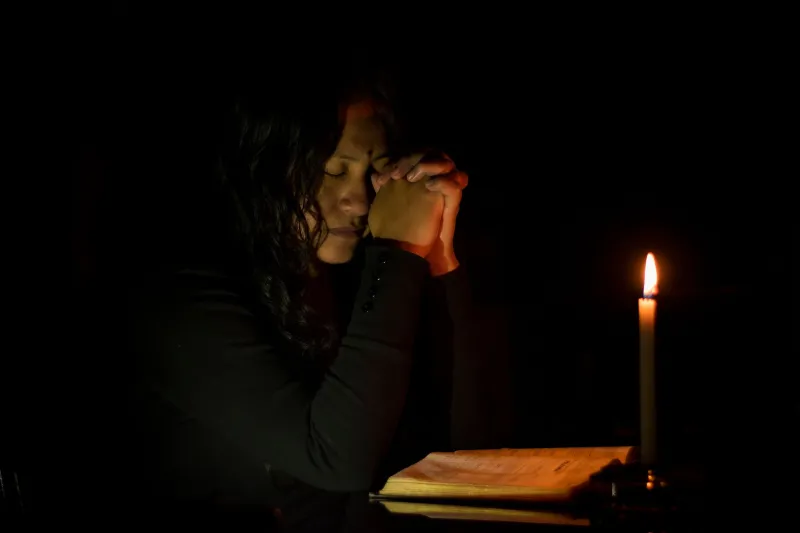
In certain Benedictine-adjacent Christian communities, practitioners are experimenting with what one oblate in Chicago describes as "secular vigils" — setting an alarm for 3:00 a.m., silencing all devices, and sitting in darkness for twenty to forty minutes before returning to sleep. "I am not in a monastery," she explains. "I have children and a job. But I have found that even a brief, intentional interruption of sleep for prayer changes the entire character of my inner life."
Buddhist practitioners in urban centers such as San Francisco and New York have increasingly turned to sleep-tracking apps not to optimize productivity, but to identify the early-morning hours when they naturally surface from deep sleep — and to use those moments for sitting practice before the demands of the day assert themselves.
What the Science Suggests
The contemplative traditions' intuition about nocturnal prayer may carry more empirical support than is commonly recognized. Research into what sleep scientists call "segmented sleep" — a biphasic pattern of sleeping in two distinct periods with a waking interval, documented by historian Roger Ekirch as the historical norm in pre-industrial societies — suggests that the midnight waking period was once commonly used for prayer, reflection, and quiet conversation. The tradition was not an ascetic imposition on the body; it may have been an expression of the body's own rhythms.
Furthermore, studies of brainwave activity during hypnagogic and hypnopompic states — those liminal thresholds between sleep and waking — reveal theta-wave dominance consistent with the states reported by experienced meditators during deep contemplative practice. The night, in other words, may offer neurological conditions that daytime prayer cannot easily replicate.
"There is something genuinely distinct about the mind at two or three in the morning," says Dr. Sánchez. "The prefrontal cortex is less assertive. The inner censor quiets. Whatever one's framework — spiritual or scientific — the conditions for a different quality of attention are present."
Reclaiming the Sacred Dark
What unites practitioners from such diverse traditions — the Muslim professional rising for Tahajjud in suburban Detroit, the Benedictine oblate sitting in darkness in a Chicago apartment, the Buddhist teacher guiding students into pre-dawn sitting in San Francisco — is a shared conviction that the night is not merely an absence of day. It is a presence in its own right, one that the world's contemplative traditions have long recognized as uniquely hospitable to the movements of the sacred.
In a culture that has declared perpetual war on darkness through artificial light, algorithmic entertainment, and the anxious compulsion to remain connected at every hour, the recovery of intentional night prayer may represent something more than personal spiritual discipline. It may constitute a quiet act of resistance — a refusal to surrender the last hours of genuine interiority to the demands of a world that never sleeps.
The vigil, in whatever form it takes, is an assertion that some hours belong to a different order of attention. That in the space between midnight and dawn, the soul may still find what the daylit world cannot provide: the particular silence in which, across every tradition that has honored the sacred dark, the deepest prayers have always been spoken.