No Fixed Address, No Fixed Altar: How Location-Independent Americans Are Reinventing Sacred Space
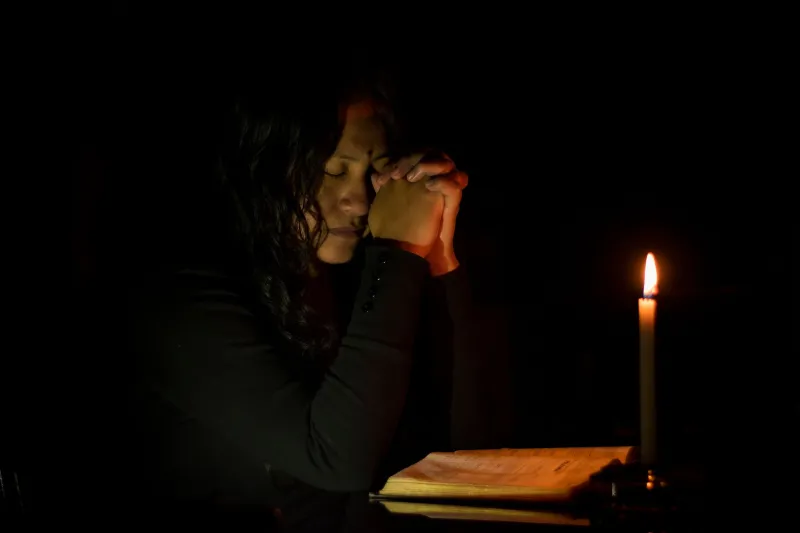
Somewhere between a Lisbon co-working space and a Chiang Mai guesthouse, Mara Delgado, a thirty-four-year-old UX designer from Portland, Oregon, unpacks the same small cloth pouch every morning. Inside: a wooden rosary her grandmother carried from Oaxaca, a travel-sized icon of the Virgin of Guadalupe printed on laminated card stock, and a single stick of copal incense she replenishes at whatever local market she can find. The ritual of unpacking takes no more than ninety seconds. The prayer that follows takes as long as it needs to.
"The pouch is the altar," she says. "Wherever I open it, that's the sacred space."
Delgado is one of an estimated seventeen million Americans who now identify as digital nomads — location-independent workers whose professional lives unfold across shifting time zones, rented apartments, and borrowed Wi-Fi. For many of them, the spiritual question is not merely logistical. It cuts to something older and more fundamental: Can a contemplative life survive without a fixed place to root itself?
The Ancient Precedent for Holy Wandering
The tension between mobility and spiritual continuity is hardly new. The Abrahamic traditions all carry founding narratives of sacred wandering — the Israelites' portable Tabernacle, the Prophet Muhammad's night journey, the itinerant ministry of Jesus of Nazareth. Sufi dervishes formalized spiritual travel as a discipline in its own right, and Buddhist monks have historically carried their entire contemplative practice within the body rather than within any building.
"There is a deep strand in almost every tradition that treats the road itself as a form of prayer," says Dr. Ananya Krishnaswamy, a scholar of comparative religion at the University of Chicago. "What nomadic practitioners today are doing is not a rupture with tradition. In many ways, they are recovering something that settled, institutional religion gradually obscured."
The challenge, Krishnaswamy notes, is that most contemporary Americans inherited their spiritual formation from traditions that had already calcified around fixed structures — the Sunday church, the Friday mosque, the Saturday synagogue. When those structures disappear from daily life, practitioners often find themselves without a template for what comes next.
The Object as Anchor
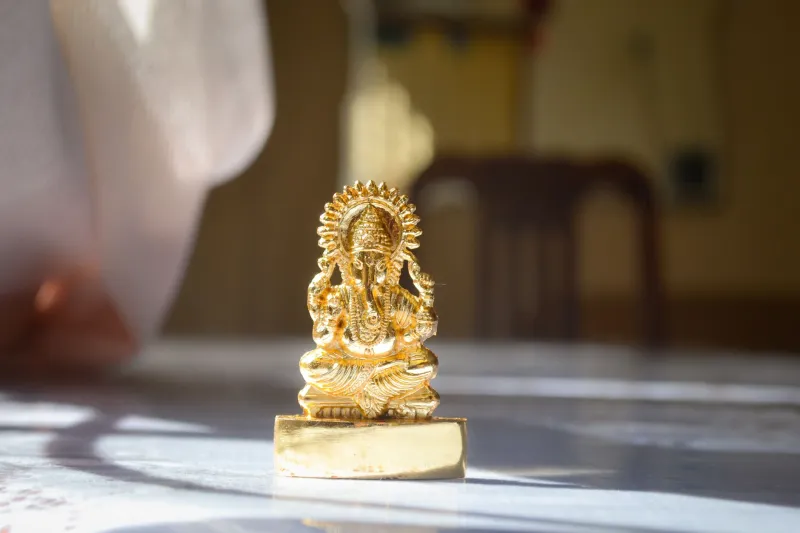
What emerges from conversations with American digital nomads across a range of spiritual backgrounds is a striking convergence on the portable sacred object as a primary tool of contemplative continuity. The specific objects vary enormously — a Japanese Buddhist mala, a small Torah scroll reproduction, a laminated card printed with a Lakota morning prayer — but the function is consistent: to transform any neutral surface into a temporary threshold between the ordinary and the sacred.
This instinct has deep cross-cultural roots. Tibetan Buddhist travelers have long carried thangka paintings that could be rolled and transported. Catholic missionaries carried portable altar stones — relics embedded in flat marble slabs — that could consecrate any surface for the Eucharist. Jewish law provides for the mezuzah, but also for the portable nature of prayer itself, which requires no building, only a minyan of ten.
Jordan Whitfield, a thirty-one-year-old software developer from Atlanta who practices a loosely Buddhist-influenced mindfulness tradition, has spent the past three years moving between cities in Southeast Asia, Eastern Europe, and Latin America. He keeps what he calls a "kit" — a folded meditation cushion cover, a small brass singing bowl, and a printed photograph of a forest near his childhood home in Georgia.
"The photograph sounds sentimental," he acknowledges. "But it's actually functional. It gives me a fixed point of return. No matter where I am — Tbilisi, Medellín, Hanoi — I look at those trees and I'm back in the same internal place."
Time Zones and the Disruption of Sacred Rhythm
If objects anchor space, time presents an equally complex challenge. Most prayer traditions are organized around specific hours — the Christian Liturgy of the Hours, the five daily prayers of Islam, the Jewish rhythm of Shacharit, Mincha, and Maariv. These structures presuppose a stable relationship between the practitioner and the sun, a relationship that dissolves when one crosses multiple time zones in a single week.
Some nomadic practitioners have responded by decoupling their practice from clock time entirely, anchoring instead to natural cues — sunrise and sunset wherever they happen to be. Others have developed hybrid schedules that honor both their home tradition's timing and the local solar rhythm. A small number have begun experimenting with what they describe as "continuous prayer" — a contemplative orientation maintained throughout waking hours rather than concentrated into discrete observances.
This last approach finds precedent in the Eastern Orthodox tradition of hesychasm, the practice of the Prayer of the Heart, as well as in the Sufi concept of dhikr — the ceaseless remembrance of the divine that is not confined to any particular hour or posture.
"The nomadic life has actually pushed me toward a more serious practice," says Delgado. "When you can't rely on a building or a community or a schedule to hold the container for you, you have to build the container yourself. That's harder. But it's also more honest."
The Risk of Spiritual Consumerism
Not everyone views the nomadic approach to spirituality with equal optimism. Critics within several faith communities have raised concerns about the tendency of highly mobile practitioners to sample traditions without sustained commitment — absorbing a Buddhist sitting practice in Bali, a sweat lodge in New Mexico, a Sufi zikr circle in Istanbul, without the relational depth that any of those traditions require for genuine transformation.
"There's a difference between carrying a tradition and collecting it," says Father Thomas Anand, a Jesuit priest and interfaith dialogue facilitator based in New York. "The portable sacred object can be a genuine anchor, or it can become a souvenir. The difference lies in accountability — to a lineage, to a teacher, to a community, even a distant one."
This distinction is one that thoughtful nomadic practitioners themselves tend to raise. Many describe maintaining regular video contact with spiritual directors, teachers, or faith communities in their home cities — a practice that technology has made possible even as it has enabled the mobility that creates the need.
What the Road Teaches
Perhaps the most unexpected finding among this community is the degree to which constant movement has deepened, rather than diluted, their contemplative lives. Stripped of habit, comfort, and the social reinforcement of a familiar congregation, many describe encountering their practice at a level of intentionality they had never previously reached.
"Every morning I have to choose to pray," says Whitfield. "There's no autopilot. No one expects me to show up. The practice survives only because I decide it will."
In this, the digital nomad's spiritual predicament may be less a modern anomaly than a return to something ancient: the recognition, present in virtually every contemplative tradition on earth, that the sacred is not ultimately housed in any building, any city, or any fixed address. It travels with the practitioner — or it does not travel at all.