Devotion in Motion: How Americans Are Building Sacred Practice for a Life That Never Stands Still

At 4:47 on a Tuesday morning, inside a half-lit terminal at Denver International Airport, a software consultant named Marcus unfolds a small square of cloth onto the seat beside him, sets a single smooth stone at its center, and closes his eyes. Around him, the terminal hums with the ambient noise of rolling luggage and distant announcements. He is, in his own quiet way, at prayer.
Marcus is not unusual. Across the United States, millions of people whose lives are defined by motion—travel nurses, long-haul drivers, touring musicians, remote workers who relocate every few months, parents who commute before dawn—are confronting a question that organized religion has not always answered cleanly: How do you maintain a sacred life when the conditions for it are never quite right?
The answers they are discovering draw from a remarkable breadth of global contemplative tradition, and they are reshaping, however quietly, what American spiritual practice looks like.
The Myth of the Ideal Conditions
Many Western religious frameworks have historically privileged place. The cathedral, the mosque, the synagogue, the temple—each represents a theology in which the sacred is most fully encountered in a designated, consecrated location. This architecture of devotion made profound sense for communities whose lives were rooted in a single geography across generations.
But certain traditions have long operated under different assumptions. The Islamic practice of Salah—the five daily prayers performed at prescribed times regardless of location—has for centuries required practitioners to orient themselves toward Mecca from wherever they stand: a merchant's tent, a ship's deck, a field at harvest. The Jewish concept of kavanah, the interior intention that animates prayer, explicitly locates the sacred within the practitioner rather than within the building. Tibetan Buddhist teachers have long taught that the mind trained in contemplation carries its monastery inward, accessible under any external circumstance.
For Americans navigating a mobile economy, these traditions are not merely interesting historical artifacts. They are functional templates.
What Travelers Are Actually Doing
The practices that mobile Americans describe are strikingly varied, yet several patterns emerge consistently.
Threshold rituals appear frequently. Rather than requiring a dedicated space, many practitioners mark the transition itself as sacred—the moment of entering a vehicle, boarding a plane, or beginning a shift. A hospice nurse in Phoenix described a breath-based practice she performs each time she crosses the threshold of a patient's room: three slow inhales paired with a silent phrase drawn from a Sufi breathing technique she encountered through an online course. "The room changes," she said. "Or I do. I'm not entirely sure which."
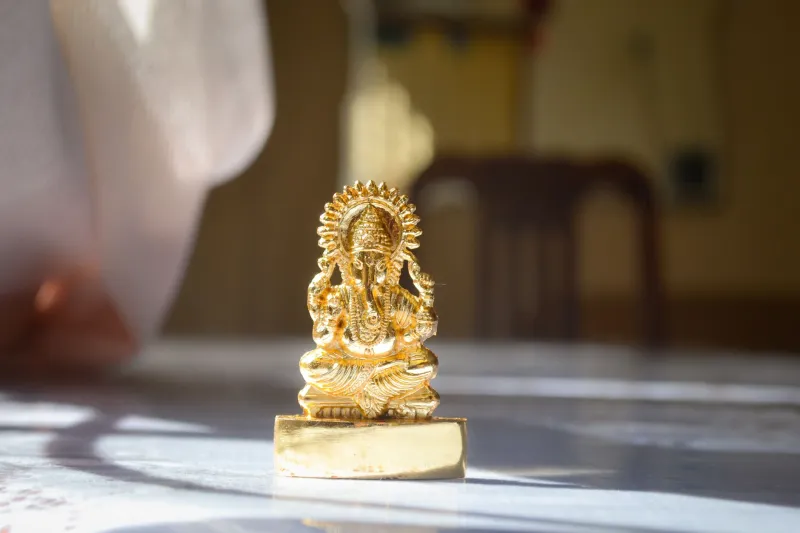
Object-based anchoring is another common strategy. The smooth stone Marcus carries, the prayer beads tucked into a jacket pocket, the small icon or image folded into a wallet—these function as what anthropologists might call portable altars, condensing the psychological and spiritual weight of a fixed sacred space into something that travels. This practice has deep global precedents: Catholic travelers have carried relics and medals for centuries; Hindu devotees maintain small murtis for personal worship; Indigenous traditions across many cultures have long included medicine bundles and sacred objects that travel with their keepers.
Sound as sanctuary represents a third approach. Several practitioners interviewed for this article described using specific chants, hymns, or recorded prayers through earbuds as a way of constructing an interior acoustic environment that functions as sacred space regardless of physical surroundings. The use of sacred sound—mantra in Hindu and Buddhist practice, dhikr in Sufi tradition, the sung psalms of Jewish liturgy—as a vehicle for entering contemplative states is among the most ancient and cross-culturally consistent spiritual technologies humanity has developed.
The Theology of Enough
Behind these practical adaptations lies a quieter theological question: Is a prayer offered under imperfect conditions worth less than one offered in ideal circumstances?
Many of the world's contemplative traditions answer with an emphatic no—and Americans in motion are finding that answer liberating. The Zen concept of ichigo ichie, the irreplaceable singularity of each moment, suggests that the distracted, imperfect, crowded moment is not an obstacle to sacred encounter but its very occasion. The Christian mystical tradition, particularly as expressed by writers such as Thomas à Kempis and later Brother Lawrence, has long held that the divine is encountered most honestly not in grand liturgical performance but in the ordinary, repetitive, unglamorous moments of daily life.
For shift workers and long-haul drivers, this reframing carries particular weight. A truck driver named Elena, who covers routes between Dallas and El Paso, described developing what she calls her "rolling rosary"—not the traditional Catholic practice, though she was raised Catholic, but a rhythmic, breath-synchronized repetition of phrases drawn from both the Hail Mary and a Lakota prayer she learned from a colleague. "The miles become the beads," she said. "At some point the road stops being the road."
Designing a Practice That Travels
For those wishing to develop portable contemplative practices, scholars and practitioners across traditions suggest several orienting principles.
Prioritize consistency of form over consistency of place. The neurological research on habit formation suggests that ritual effectiveness is tied less to environmental cues than to the reliable repetition of a specific sequence of actions. Choosing a practice with a clear, repeatable structure—a fixed number of breaths, a specific sequence of phrases, a particular physical gesture—allows the body to recognize and enter a contemplative state even in unfamiliar surroundings.
Work with time rather than against it. Many global traditions have organized prayer around natural temporal markers—dawn, noon, dusk, midnight—rather than around architectural ones. Aligning practice with these universal rhythms, rather than with a specific building's schedule, creates a form of sacred continuity that travels across time zones.
Carry something that carries meaning. The use of a physical object as a contemplative anchor is not superstition; it is cognitive scaffolding. The object externalizes intention and provides a sensory cue that the nervous system can learn to associate with a shift in attention.
Motion as Its Own Spiritual Metaphor
There is, finally, something worth sitting with in the fact that so many Americans are discovering their deepest spiritual resources precisely in the midst of movement. Pilgrimage—the sacred journey undertaken as an act of devotion—is among the most universal of human spiritual practices. The hajj, the Camino de Santiago, the Char Dham yatra, the vision quest: across traditions and continents, humanity has repeatedly intuited that movement itself, undertaken with intention, is a form of prayer.
The American who prays in a terminal, or chants on a commute, or performs a threshold ritual before a night shift, may be participating in something older and more universal than they realize. The path, in many of the world's wisest traditions, has always been the destination.
For Marcus, folding his cloth back into his carry-on as his boarding group is called, the practice is simpler than any of this. "I just needed something that would come with me," he said. "Turns out, the most important things always do."